
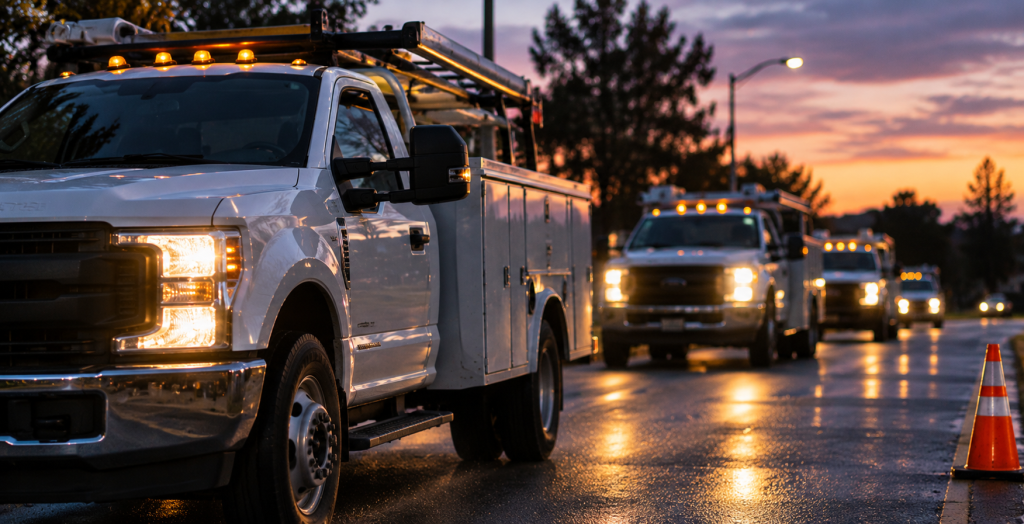
The clocks go back this Sunday, November 1. Monday afternoon, your drivers finish their routes in the dark.
Most people treat that as an inconvenience. For a business running vehicles it is a measurable change in risk, and it arrives on a known date every year, which makes it one of the few exposures you can actually prepare for.
What the data says
The Insurance Institute for Highway Safety laid this out in testimony to the Senate Commerce Committee, and the numbers are worth knowing even if you never think about insurance again.
- Fewer than a quarter of trips begin at night, but nearly half of vehicle occupant deaths happen in the dark.
- Seventy-seven percent of pedestrian deaths happen in the dark.
- In an IIHS study covering 2010 through 2019, in the five weeks after the fall time change, crashes killing pedestrians or cyclists rose 13 percent. Crashes killing vehicle occupants fell 7 percent over the same window.
- Vehicles with good-rated headlights had 23 percent fewer nighttime pedestrian crashes than vehicles with poor-rated ones.
Read the last one again. That is not driver behavior or training. That is equipment, and it is the cheapest thing on this list to fix.
The pattern is not that darkness makes drivers worse. It is that the same volume of traffic moves into conditions where a person outside a vehicle is much harder to see, and the consequences of missing them are fatal rather than expensive.
Why this is an insurance problem and not just a safety one
Frequency and severity are different things, and this change moves severity.
A fender bender in daylight is a claim. A pedestrian struck at dusk is a different category of event entirely, and it is the kind of loss that reprices an account. Commercial auto is already the hardest line in the market to place well, and a single serious injury claim does not just cost you that claim. It sits in your auto loss runs for years and shows up in every submission your broker makes. And if the person hurt is one of your own employees, the same incident also produces a workers’ compensation claim, and that one moves your experience modification for three years.
That lag is the part owners underestimate. A bad November shows up in pricing well into 2029.
Who this actually lands on
If your people are on the road or beside it after 5pm between now and March, this is your season:
- Trucking and transport. Longer runs finishing in the dark, and drivers at the end of a shift rather than the start.
- Towing and roadside. Your people stand on a live shoulder for a living, and now they do it in the dark. This is the highest-exposure group on the list.
- Sanitation and refuse. Early starts already meant darkness at one end. Now it is both ends.
- Non-emergency medical transport. Loading and unloading passengers curbside, often with mobility equipment, in the dark.
- Delivery and service fleets. The afternoon run now finishes under streetlights.
- Construction and trades. Site traffic, equipment moves and the drive home after a long day.
What to do in the next week
None of this is expensive. All of it is easier to do before a claim than to explain after one.
Walk the fleet and look at the headlights. Not whether they turn on. Whether the lenses are clouded, whether the aim is right, whether anything is burned out. Oxidized plastic lenses cut output dramatically and almost nobody checks them. Given the 23 percent figure above, this is the highest-return hour you will spend this month.
Check the rest of the glass and the wipers. A worn blade or a pitted windshield turns oncoming headlights into glare. Same for interior dash lights set too bright.
Put reflective gear on anyone who leaves the vehicle. Tow operators, sanitation crews, drivers doing curbside work. High-visibility outerwear, not just a vest left on the seat. If your people work a shoulder, this is not optional.
Look at whether the schedule can move. Not every route can shift, but some can. Pulling the last stop forward by forty-five minutes in November is a real risk reduction, and it costs nothing but planning.
Talk to drivers about the first two weeks specifically. The adjustment period is when people misjudge distance and closing speed most. A five-minute conversation at a Monday morning huddle is enough.
Check your telematics or camera coverage. Two reasons. It reduces the behavior that causes crashes, and when a disputed nighttime accident comes down to one account against another, footage is the difference between settling and defending.
Pull MVRs if you have not this year. Driver quality is the single biggest predictor of loss in any fleet, and darkness amplifies whatever your drivers already are.
What underwriters see
When your renewal gets marketed, the carrier is reading two things: your loss runs, and whether you look like an operation that manages risk or one that reacts to it.
The second part is not window dressing. Documented driver standards, MVR discipline, a written post-accident procedure, telematics, and a maintenance record all change how an account gets priced, particularly in a class where the carrier pool is small. Two fleets with identical loss histories do not get identical quotes if one of them can show a program and the other cannot.
Seasonal preparation is a cheap thing to be able to point at.
Where we come in
We place commercial auto for trucking, towing, sanitation, medical transport, delivery and service fleets, and we spend most of our time on the part that happens before a renewal rather than after it.
Send us your current declarations page, your vehicle schedule and your driver list. We will tell you whether your limits match what your contracts actually require, whether every vehicle you own is on the policy, what your covered auto symbols mean for the truck you bought last month, and where your program is thin. If it is built correctly we will tell you that too.
If you want the detail on how the underlying policy works, our commercial auto page covers it. For fleets that haul, the transportation page goes further, and operators working the shoulder should read the towing and roadside assistance page. One specific trap worth ten minutes before your next purchase is covered in our piece on covered auto symbols.
Call us at (888) 590-2667 or send the paperwork over and we will take it from there.
This article is general information about fleet risk and commercial auto insurance. It is not legal advice and it is not a description of any specific policy. Crash statistics cited are from Insurance Institute for Highway Safety testimony before the United States Senate Committee on Commerce, Science, and Transportation and the IIHS study of 2010 to 2019 data referenced in it. Coverage is determined solely by the terms, conditions and exclusions of the policy you hold.
