
Goldbridge Insurance Services
Pumping, installation, drain field work, grease traps and sewer cleaning. We place workers’ compensation, commercial auto, general liability and pollution coverage for California septic contractors, and we read the forms before you sign them.
Septic work sits in an awkward place in the insurance market. It looks like plumbing to an underwriter who has not read the operation, it gets rated like refuse hauling when the payroll lands in the wrong class, and the one exposure that defines the trade, which is what happens when waste ends up somewhere it should not be, is excluded by default on the policy most operators are sold.
This page explains how a septic program is actually built in California: which workers’ compensation classification applies to which part of your operation, why the pollution exclusion matters more here than almost anywhere else, what the C-42 license does and does not let you do, and the county registration that expires every December 31 whether anyone reminds you or not.
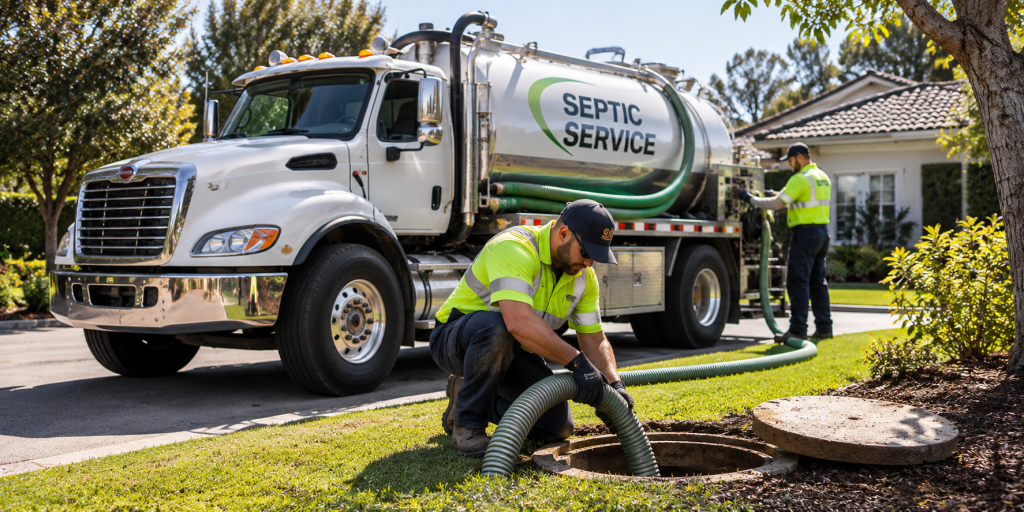
A plumber works inside property lines on pipe you can reach. A septic operator works on a buried tank, a leach field, a vacuum truck carrying several thousand gallons of untreated waste, and sometimes a confined space that can kill a person in under a minute. Those are not the same risk, and carriers do not price them the same way.
Three things drive your cost, in this order:
California classifications are set by the Workers’ Compensation Insurance Rating Bureau, and for septic work the governing classification is 9426, Septic or Portable Toilet Services. Its official phraseology is “cleaning of septic tanks, cesspools or portable toilets — all employees.”
What 9426 covers, per the WCIRB’s own footnote to the classification:
That third item is worth noting if you run grease trap work alongside septic. It stays in 9426.
What does not belong in 9426, again from the footnote:
| If the work is | It belongs in |
|---|---|
| Fee-based cleaning of main sewer lines or storm drains, and you are not a public agency | 9402, Sewer, Tank or Hazardous Spill Cleaning |
| Cleaning waste pipe no larger than 6 inches in diameter, within property lines | 5183(1) / 5187(1), Plumbing |
| Removing petroleum or petroleum-contaminated material from tanks by vacuum truck | 6206(3), Oil or Gas Wells, vacuum truck service companies |
| Contract hauling and disposal of waste, roll-off container transport, household or commercial waste collection, curbside recyclables | 9403(1), Garbage or Refuse Collecting |
| Construction of sewer lines and septic systems | Separately classified: 6307 / 6308, Sewer Construction |
| Operating a sanitation district or sewage disposal plant, or cleaning sewer lines and storm drains as a public agency | 7580, Sanitary or Sanitation Districts Operation |
Most septic companies in California do more than one of these. A company that pumps tanks, snakes a 4-inch lateral inside a property line, and installs a replacement system in the same week has payroll that belongs in three different classifications. Whether it gets split correctly is the difference between a defensible audit and a bill you did not expect.
The WCIRB publishes an advisory pure premium rate for each classification. It is a benchmark, not what any carrier charges you: insurers file their own rates, and your experience modification, schedule rating and carrier appetite all move the final number. But the advisory rate tells you the relative cost of being in one class instead of another, and that relationship holds no matter who writes the policy.
Rates below are the approved pure premium rates effective September 1, 2026, per dollar of payroll expressed per $100:
| Code | Classification | Pure premium rate |
|---|---|---|
| 9426 | Septic or Portable Toilet Services | $6.826 |
| 9402 | Sewer, Tank or Hazardous Spill Cleaning, N.O.C. | $4.123 |
| 6307 | Sewer Construction, regular hourly wage under $45.00 | $7.451 |
| 6308 | Sewer Construction, regular hourly wage $45.00 or more | $4.117 |
| 5183(1) | Plumbing, regular hourly wage under $35.00 | $5.716 |
| 5187(1) | Plumbing, regular hourly wage $35.00 or more | $2.732 |
| 9403(1) | Garbage or Refuse Collecting | $7.555 |
Two things jump out of that table.
The advisory rate for 9426 was $5.450 effective September 1, 2024, $5.790 effective September 1, 2025, and $6.826 effective September 1, 2026. That is a 17.9 percent increase in the last year and 25.2 percent over two years.
If your premium went up and nobody explained why, that is a large part of the answer. It is not your carrier singling you out. The benchmark for the whole classification moved.
Sewer construction is a dual wage classification. Payroll for an employee whose regular hourly wage is $45.00 or more goes in 6308 at $4.117. Payroll for an employee below that wage goes in 6307 at $7.451. That is a 45 percent difference in the advisory rate, decided entirely by whether a crew member’s regular hourly wage reaches $45.00.
Plumbing works the same way at a lower threshold: $35.00 an hour separates 5183(1) at $5.716 from 5187(1) at $2.732, which is more than half.
The audit catches this. Assignment of the high wage classification is subject to verification at final audit. If you cannot show that an employee’s regular hourly wage equaled or exceeded the threshold, that payroll gets moved to the low wage class and you are billed the difference. Payroll records that prove the wage are not paperwork, they are the coverage.
This is the section to read twice.
Most commercial general liability policies sold today contain a broad pollution exclusion. Its practical effect is that bodily injury or property damage arising out of the discharge, dispersal, release or escape of a pollutant is not covered. Untreated sewage and septage are pollutants under that language.
Read that against what you do for a living. A tank overflows onto a lawn. A leach field you installed surfaces into a neighbor’s yard. A hose fails while you are pumping and several hundred gallons go into a storm drain. A load shifts and your truck discharges on a public road. Every one of those is the core risk of the trade, and on an unendorsed general liability policy every one of them may fall outside coverage.
Operators discover this at the worst possible moment. The claim comes in, the adjuster cites the pollution exclusion, and the answer is that the policy was never built for the work.
What a correctly built septic program does instead:
Your trucks are the most visible part of the operation and often the largest line on the program after workers’ compensation.
Four things to get right:
Limits that match the contracts you actually sign. Municipal work, property management companies and general contractors frequently require a combined single limit of $1 million and sometimes more, with the written contract controlling. Buying to the state minimum and then signing a contract that demands more is a problem you create for yourself.
Covered auto symbols. Symbols determine which vehicles your liability coverage actually attaches to. The common failure is a schedule-based symbol combined with a truck bought mid-term that nobody reported. If you have ever added a vacuum truck and told the broker a week later, read our piece on covered auto symbols and newly acquired vehicles. It is a ten-minute read that has saved accounts.
Physical damage on equipment that is worth more than a pickup. A tandem-axle vacuum truck is a substantial asset. Comprehensive and collision deductibles, stated values and whether the tank and pump are valued as part of the vehicle all deserve an actual conversation rather than a default.
The pollution problem on the auto side. A business auto policy contains its own pollution exclusion, and the way it treats a discharge of the property you are transporting is not the same as the way it treats fuel or fluids from the vehicle itself. The scope of any pollution coverage added back by endorsement varies by carrier and by form. For a company whose trucks exist to carry waste, this specific wording is worth more attention than the premium difference between two quotes.
Pumps, hoses, jetters, cameras, locators, tanks and portable units are not covered by your commercial auto policy when they are off the truck, and they are not covered by your general liability policy at all. That exposure belongs on an inland marine or contractors equipment form.
Two details that matter more in this trade than most: whether a jetter or camera rig is scheduled individually or picked up under a blanket limit, and whether the policy covers equipment in transit, at a job site, and in the yard overnight. See our inland marine and contractors equipment page for how those forms work.
If any part of your business involves designing a system, performing a real estate transfer inspection, or certifying that a system functions, you have taken on a professional exposure. A buyer who relies on your inspection and then replaces a failed system is making a claim about your professional judgment, not about property damage you caused, and a general liability policy is not built to respond to it.
That exposure belongs on a professional liability or contractors errors and omissions form. Operators who only pump do not need it. Operators who sign off on systems generally do.
This distinction causes real confusion, including among brokers.
The Contractors State License Board classification for septic work is C-42, Sanitation System Contractor. The official scope, in the CSLB’s own words, is that “a sanitation system contractor fabricates and installs cesspools, septic tanks, storm drains, and other sewage disposal and drain structures,” and the classification “includes the laying of cast-iron, steel, concrete, vitreous and nonvitreous pipe and any other hardware associated with these systems.”
Read what that scope describes: fabrication and installation. The words pumping, cleaning and maintenance do not appear in it. A C-42 license is the license for building and replacing systems.
Pumping is regulated on an entirely separate track, by a different authority, and most operators underestimate it.
California Health and Safety Code section 117405 makes it unlawful for any person or firm to engage in the business of cleaning septic tanks, chemical toilets, cesspools or sewage seepage pits, or to dispose of the cleanings from them, in any city, town, county, or city and county, unless it holds an unrevoked registration issued by the local health officer for that jurisdiction.
Four consequences follow from the way that article is written:
No insurance policy covers a criminal fine. That is worth saying plainly, because the reflex in this trade is to treat compliance and insurance as the same budget line. They are not. A misdemeanor conviction is yours, and it also becomes an underwriting fact that follows the account.
The health officer may also require you to file statements, at whatever frequency they choose, listing the name and address of the owner or tenant of each tank you cleaned, under section 117435. If your office does not keep that record cleanly, a records request is an unpleasant week.
The State Water Resources Control Board regulates onsite systems through the Water Quality Control Policy for Siting, Design, Operation and Maintenance of Onsite Wastewater Treatment Systems, generally called the OWTS Policy. It was adopted June 19, 2012, took effect May 13, 2013, and was amended April 18, 2023.
The Policy sorts systems into tiers. Tier 0 covers properly functioning systems needing no corrective action. Tier 1 covers new or replacement systems meeting the Policy’s conservative siting and design standards, up to 3,500 gallons per day. Tier 2 covers new or replacement systems built to the standards in a Local Agency Management Program, or LAMP, approved for that county, up to 10,000 gallons per day. Tier 3 covers systems near surface waters that are impaired and subject to a Total Maximum Daily Load. Tier 4 covers systems that are not functioning properly.
Two points that matter commercially:
The maintenance duty sits on the owner. Section 2.5 of the Policy provides that owners shall maintain their systems in good working condition, including inspections and pumping of solids as necessary or as required by local ordinances. That is the regulatory basis for the service you sell, and it is a better reason for a property owner to be on a pumping schedule than anything in a sales script.
Which county you are in changes the rules. Because Tier 2 runs through a locally approved LAMP, the siting and design standards you work to are not uniform across California. A LAMP must also address the training, certification or licensing of pumpers and maintenance contractors under section 9.2.4. If you cross county lines, you are working under more than one rulebook, and so is your customer.
A septic tank is a confined space with an oxygen-deficient, potentially toxic atmosphere. Hydrogen sulfide at high concentration can incapacitate a person in a breath or two. Entries go wrong fast, and they frequently take a second person who went in to help.
Cal/OSHA’s permit-required confined space rules apply, and compliance is not a binder. It is atmospheric testing before entry, ventilation, an attendant outside, retrieval equipment, a written permit, and trained rescue that does not consist of a coworker climbing in. Carriers in this class ask about it because the severity on a confined space fatality is enormous and it is a loss that puts an account out of the standard market.
If you have crews who open tanks, this is the single highest-value hour of safety work available to you, and it also happens to be the thing that makes an underwriter take the submission seriously.
Three laws signed in 2026 take effect January 1, 2027 and land directly on this trade.
SB 1444 amends the willful misclassification statute so that each employee, in addition to the Labor Commissioner or a public prosecutor, may recover the statutory civil penalties as damages payable to the employee. If you use subcontracted pump operators or 1099 drivers, the cost of getting classification wrong just became easier for a worker to collect.
AB 2321 makes it a misdemeanor to willfully resist, prevent, impede or interfere with the Cal/OSHA chief or an authorized representative carrying out investigation and inspection duties. It also requires the division to immediately notify the prosecuting authority when it learns of an accident involving a death, a serious injury, illness or exposure affecting five or more employees, or a request for prosecution. For a trade with confined space exposure, how your supervisor handles the first hour of an inspection now carries criminal consequences.
AB 2155 adds a provision to the Code of Civil Procedure making an arbitration agreement unenforceable to the extent it is unenforceable under the Federal Arbitration Act, and the bill states its purpose as incorporating the Act’s exclusions into California law, including contracts of employment of any class of workers engaged in foreign or interstate commerce. If you have drivers on arbitration agreements, that agreement deserves a look from your employment counsel before January.
The state minimum wage also rises on January 1, 2027, and many city and county minimums rise with it.
When we market a septic account, the carrier is reading a short list:
That last one is not decoration. In a class with a small carrier pool, two operators with identical losses do not get identical pricing if one can show a program and the other cannot.
If some of that is missing, send what you have. We would rather start the conversation than wait for a perfect file.
Classification 9426, Septic or Portable Toilet Services, applies to the cleaning of septic tanks or cesspools by vacuum truck. The same classification covers portable toilet rental and the removal of effluent and cooking grease from tanks by vacuum truck where no actual tank cleaning is performed. Installation of septic systems and construction of sewer lines are classified separately.
Often it does not. Most general liability forms contain a broad pollution exclusion, and untreated sewage falls within the definition of a pollutant. Pollution coverage for a septic operation generally has to be bought deliberately, either as a separate contractors pollution liability policy or by endorsement, and the scope varies significantly between carriers. The form has to be read.
The C-42 Sanitation System Contractor classification covers fabricating and installing cesspools, septic tanks, storm drains and other sewage disposal structures. Its scope does not describe pumping or cleaning. Pumping is instead regulated under Health and Safety Code section 117405, which requires an unrevoked registration issued by the local health officer in each jurisdiction where the business is carried on.
Every year. Health and Safety Code section 117430 provides that registration runs only for the unexpired portion of the calendar year in which the application is made, and that all registrations become void at the end of the calendar year. A registration issued in August expires on December 31 of that same year.
Health and Safety Code section 117450 makes a violation of the article a misdemeanor, punishable by a fine of not less than $200 for each offense, or imprisonment of not less than 30 days, or both. No insurance policy covers a criminal fine.
Part of it is the classification itself. The approved advisory pure premium rate for class 9426 rose from $5.450 effective September 1, 2024 to $5.790 in 2025 and $6.826 effective September 1, 2026, which is roughly a 25 percent increase over two years. Advisory rates are not what a carrier charges, but they move the whole market for a class.
Sewer construction is a dual wage classification, with the dividing line at a regular hourly wage of $45.00. Payroll at or above that wage is classified 6308 and payroll below it is classified 6307, and the advisory rates differ by about 45 percent. The high wage classification is verified at final audit, so payroll records have to actually prove the wage.
Not by your commercial auto policy, and not by general liability. Pumps, jetters, cameras, locators and hoses belong on an inland marine or contractors equipment form, which should address equipment in transit, at the job site and in the yard.
We will tell you where your program is thin, in writing, before you decide anything.
Call (888) 590-2667 or send the paperwork over.