
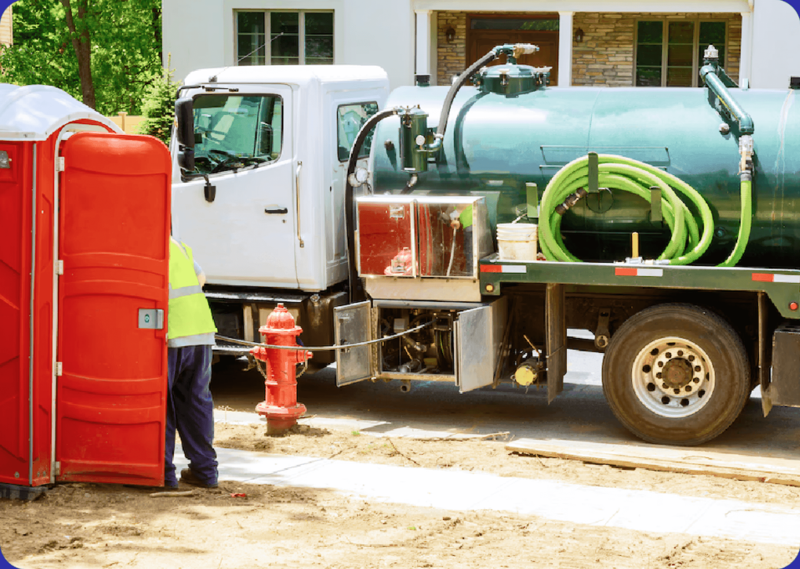
Two things happened to portable sanitation operators in California this month, and only one of them shows up on an invoice.
The first is a rate move. On September 1, 2026, the advisory pure premium rate for class code 9426, Septic or Portable Toilet Services, went from $5.790 to $6.826 per $100 of payroll. That’s a 17.9 percent increase in one year, against a statewide advisory increase of 6.6 percent across all California employers.
The second is something that was already true and stays true no matter what your renewal comes in at. The material in your tank is excluded under both your general liability policy and your commercial auto policy. Not limited. Excluded.
Most operators in this trade are carrying three policies they believe cover the business. For the single most likely large loss, two of the three are silent.
Start with the class code, because a lot of firms are in the wrong one
California has a dedicated classification for this work. It’s 9426, and the phraseology reads: “SEPTIC OR PORTABLE TOILET SERVICES — cleaning of septic tanks, cesspools or portable toilets — all employees.”
The footnote is more useful than the title. 9426 applies to vacuum truck cleaning of septic tanks and cesspools. It also applies to the rental of portable toilets, including delivery, placement, service and repair at customer locations or at your own yard. And it applies to removing effluent and cooking grease from tanks by vacuum truck when no actual tank cleaning is performed.
Here’s where the rate has gone:
- September 1, 2024: $5.450
- September 1, 2025: $5.790
- September 1, 2026: $6.826
Worth repeating what a pure premium rate is and isn’t, because it gets misread constantly. It’s an advisory loss benchmark, not what you pay. Carriers file their own rates and add their expenses and profit on top. A 17.9 percent move in the benchmark doesn’t automatically become 17.9 percent on your renewal. What it means is that every underwriter pricing this class in California just got a materially worse loss picture, and the credits that were easy to hold last year are going to be harder.
The four codes a sanitation company can straddle
This is where real money gets lost, in both directions, and it’s the part almost nobody checks.
Most operators in this trade don’t do only one thing. They run porta potties, they pump grease traps, they do some roll-off hauling, they jet a line when a customer asks. The classification system treats those as different work:
- 9426, Septic or Portable Toilet Services — $6.826. Your core work.
- 9402, Sewer, Tank or Hazardous Spill Cleaning — $4.123. Fee-based cleaning of main sewer lines or storm drains, when you’re not a public agency. Also fee-based tank cleaning and onshore cleanup after oil or chemical spills.
- 9403(1), Garbage or Refuse Collecting — $7.555. Contract hauling and disposal of waste, roll-off container transport, household and commercial waste collection.
- 5183(1)/5187(1), Plumbing — a construction dual wage class. Cleaning waste pipe that doesn’t exceed 6 inches in diameter within property lines.
Read those rates again. Hazardous spill cleanup is rated at $4.123 and portable toilets are rated at $6.826. Cleaning up after a chemical spill carries a lower expected loss rate than servicing porta potties. That is not what anyone would guess, and it’s exactly why you shouldn’t guess.
One more boundary that catches people: removing petroleum or petroleum-contaminated material from tanks by vacuum truck isn’t any of the above. It goes to 6206(3), Oil or Gas Wells — vacuum truck service companies.
If your whole payroll sits in one code because that’s what the policy said when you started, there’s a decent chance you’re either overpaying on work that belongs in a cheaper class or underreporting work that belongs in a more expensive one. The first costs you money quietly every month. The second gets discovered at audit, with interest.
Now the part that isn’t about premium
A standard commercial general liability policy defines pollutants broadly: any solid, liquid, gaseous or thermal irritant or contaminant, including smoke, vapor, soot, fumes, acids, alkalis, chemicals and waste. Waste is named in the definition. It includes materials to be recycled, reconditioned or reclaimed.
Sewage is waste. Septage is waste. Grease trap contents are waste.
The CGL pollution exclusion has several parts, and the part that covers waste handling, storage, disposal, processing or treatment is the harshest of them. The other parts of the exclusion carry exceptions. That one doesn’t.
So your GL, the policy you hand out certificates for all day, is not the answer when the loss involves the material you were hired to remove.
Your auto policy doesn’t pick it up either
People assume the commercial auto policy covers it, because the truck is a covered auto and the spill came off the truck. It doesn’t work that way.
The standard business auto form excludes bodily injury and property damage arising out of the discharge, dispersal, seepage, migration, release or escape of pollutants that are being transported or towed by, handled, or handled for movement into, onto or from the covered auto.
There’s an exception, and it’s narrow. It’s for fuels, lubricants, fluids and exhaust gases needed for the normal operation of the vehicle, escaping from a part the manufacturer designed to hold them. Your diesel tank is covered. Your waste tank is cargo.
Picture the actual claim. A full truck rolls on the 5. Auto liability responds to the other vehicle and the injuries. The load that came out of the tank, across two lanes and into a storm drain, is a different story. The response, the agency cleanup order, the damage to whatever it reached, none of that is the auto policy’s problem under the unendorsed form.
Three places a loss happens, three different answers
At the customer’s location. A hose lets go during a pump-out. A unit tips at an event and the tank opens on a lawn or a parking lot that drains somewhere. A line leaks onto a driveway and into a gutter.
In transit. Rollover, collision, valve failure, an overfilled tank on a grade.
At the disposal site. This is the one with the longest tail, and the one operators think about least, because the load is somebody else’s problem once it’s off your truck. That isn’t how environmental liability allocates. The party that generated or delivered the material can be brought into a cleanup years later.
What actually closes the gaps
Two things, and neither is automatic.
On the auto side, there’s an endorsement built for exactly this. Pollution Liability – Broadened Coverage for Covered Autos, filed as CA 99 48 and CA 31 10 depending on the form edition. It buys back coverage for pollutants discharged from a covered auto, including material carried as cargo, along with cleanup and response costs. It is not unlimited and it does not turn your auto policy into an environmental policy. Coverage around loading and unloading in particular can be narrower than people expect. But the difference between having it and not having it, on a rollover with a full tank, is the difference between a covered claim and a company-ending one.
Go look at your declarations page. If neither form number appears, you don’t have it.
On the operations side, contractors pollution liability is the separate policy that responds to the work itself, at the customer’s site and at the disposal end. It’s a real line with real underwriting, not a checkbox on the GL.
Your disposal paperwork is part of your coverage
Counties regulate this trade directly, and the requirements aren’t decorative.
San Bernardino County, to take one published example, requires a health permit for anyone servicing or transporting sanitary waste from septic tanks, portable toilets and similar facilities. Disposal is only allowed at sites the county’s environmental health department has approved, meaning facilities holding current, unrevoked waste discharge requirements or a current, unrevoked solid waste disposal site permit. Operators also have to give the customer a receipt or bill showing the number of compartments pumped, the estimated volume removed, the intended discharge location and the estimated disposal charges.
Other counties have their own versions. Check yours, because the specifics vary.
The insurance angle is simple. Dump somewhere not approved and you don’t just have a regulatory problem, you have a coverage problem, because no policy responds well to a knowing violation. And when a disposal site question surfaces three years later, the operator who can produce records showing what went where is in a completely different position than the one who can’t. The manifests and receipts are not busywork. They’re the evidence that you weren’t the problem.
One thing on the driver side
A tank vehicle endorsement is required in California for a commercial vehicle hauling liquid in a tank with an individual rated capacity of more than 119 gallons and an aggregate rated capacity of 1,000 gallons or more, whether the tank is permanently or temporarily attached, on a Class A, B or C commercial license.
Most service trucks in this business clear that threshold without anyone thinking about it. Running a driver without the endorsement is a citation on a good day. On a bad day it’s the first thing opposing counsel puts in front of a jury, and the first thing your carrier asks about at renewal.
What to pull this week
- Your WC policy. Which class codes are listed, and does the payroll split match what your crews actually do?
- Your auto dec page. Search it for CA 99 48 or CA 31 10. If neither is there, your cargo is excluded.
- Your GL. Confirm what the pollution exclusion says and whether any buyback was ever added. Usually it wasn’t.
- Whether you carry contractors pollution liability at all. A lot of operators in this trade don’t, and don’t know it.
- Your county health permit. Current, and covering every vehicle and unit it needs to.
- Driver files. Tank endorsements on everyone who needs one.
Where to go from here
We write this class and we know what the trucks actually do, which matters more than it sounds like it should. Our sanitation and portable restroom services page covers how the program is usually built, and our earlier piece on why portable toilet companies need more than workers’ comp is the shorter overview if you want the lay of the land first.
If you want a second set of eyes, send your current declarations pages and we’ll tell you which class codes you’re in, whether your auto policy has the pollution endorsement, and where the gaps are. If your program is already built right, we’ll tell you that too.
Get in touch and we’ll take a look.
This article is general information about how these policies are typically structured. It isn’t legal advice and it isn’t a description of any specific policy. Coverage is determined solely by the terms, conditions and exclusions of the policy you actually hold, and permit requirements vary by county. Verify your own county’s rules with its environmental health department.
Sources: WCIRB California classification records for 9426, 9402 and 9403(1); California Department of Insurance decision on the September 1, 2026 pure premium rate filing; ISO Commercial General Liability and Business Auto coverage forms; San Bernardino County Department of Environmental Health Services liquid waste pumper requirements; California DMV Commercial Driver Handbook.
